

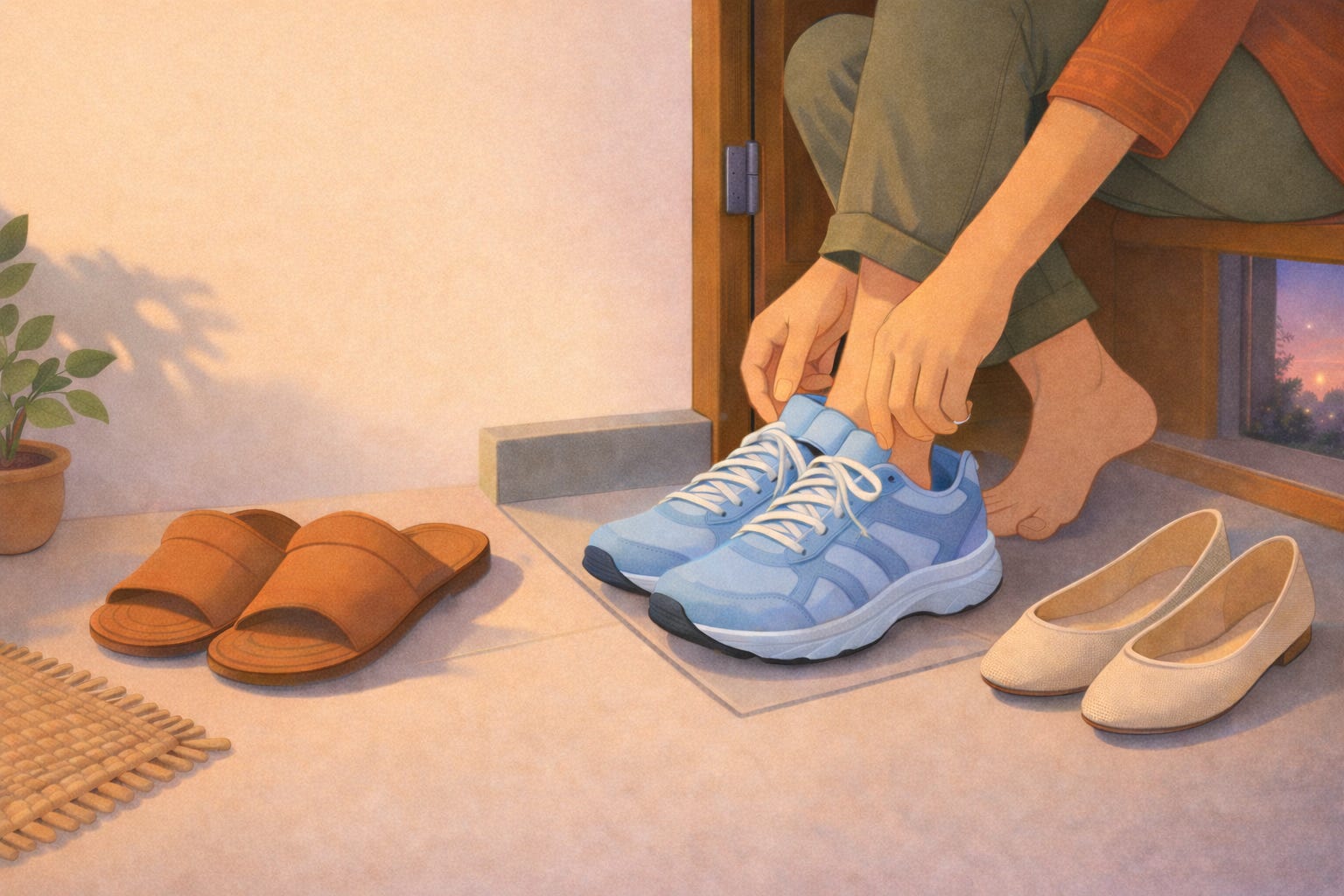
Last week, I shared a quick post in our joint health community about footwear rotation - switching your shoes 2-3 times a day. The response caught me off guard. People were genuinely surprised that footwear variety even mattered for joint health. Honestly? I was curious too. I knew the basics, but I wanted to understand the actual science behind it.
So I dug deeper. And what I found was fascinating.
It’s Not Just About Comfort - It’s About Adaptation
It’s not that your shoes are wrong, it’s that wearing the same ones all day locks your body into a single movement pattern.
Here’s what most people don’t realize: your body is incredibly good at adapting to whatever stress you put on it. When you wear the same shoes all day, your body doesn’t just “get used to it” - it starts compensating.
Flat chappals might cause your foot to pronate (roll inward) more. Your ankle compensates by adjusting its angle. Your knee shifts slightly to balance the load. Your hip tilts to keep you stable. None of these changes are dramatic - they’re tiny, automatic adjustments your body makes without you even noticing. 1
But here’s the problem: do this for 10,000 steps a day, every single day, and those tiny compensations become movement patterns. Your joints groove into the same positions, your muscles fire in the same sequence, and specific areas bear the brunt of the load repeatedly. Research shows that different footwear significantly alters joint angles, muscle activation, and force distribution throughout your entire lower body, not just your feet. 2
Over months and years, this repetitive stress can contribute to wear patterns in cartilage, muscle imbalances, and chronic joint pain.
The Running World Figured This Out First
Interestingly, runners have known about shoe rotation for years. Studies on running biomechanics found that alternating between different shoe types reduces injury risk, not because any single shoe is “bad,” but because variation prevents overuse patterns from developing. 3
One study tracking runners who rotated shoes found they had a 39% lower injury risk compared to those who stuck with one pair. 4 The principle applies whether you’re running marathons or just walking to the market: variety in mechanical stress protects your joints.
Why Switching Works at a Deeper Level
When you change your footwear throughout the day, you’re doing more than giving your feet a break. You’re forcing your body to adapt to different movement patterns.
Supportive shoes with cushioning might reduce impact forces on your knees. Flatter footwear engages your arch and calf muscles differently. Even slight variations in heel height change how your weight is distributed from your toes all the way up to your lower back. 5
This constant variation keeps your muscles engaged in different ways and prevents any single joint structure from being overloaded. Think of it like cross-training for your joints, except you’re doing it just by changing your shoes.
What Actually Matters
Here’s the practical part: you don’t need expensive orthopedic shoes or a closet full of footwear. You just need variety in how your feet interact with the ground.
Try this rotation:
Morning at home: Supportive chappals or slippers
Midday/outdoors: Cushioned walking shoes with arch support
Evening: Lighter, flatter footwear
The key is mixing different levels of support, cushioning, and heel heights throughout the day. Even rotating between two similar pairs makes a difference because no two shoes distribute pressure identically - slight variations in wear patterns, sole thickness, or fit mean your body experiences different loading.
The Real Insight
Joint health isn’t just about supplements, exercise, or diet. It’s also about the thousands of micro-stresses your body experiences every single day. Most of us focus on the big things - working out, eating right - but overlook the fact that we’re standing, walking, and moving for 12+ hours daily in the exact same mechanical pattern.
Your joints weren’t designed for that kind of monotony. They need variety just like your muscles need different types of movement and your diet needs different nutrients.
So the next time you slip into those comfortable shoes you’ve been wearing all day, ask yourself: Am I giving my joints the variety they need, or am I locking them into the same stress pattern hour after hour?
Small change. Big impact. Your knees will thank you in 10 years.
For the curious, here are the references behind the research mentioned above: