

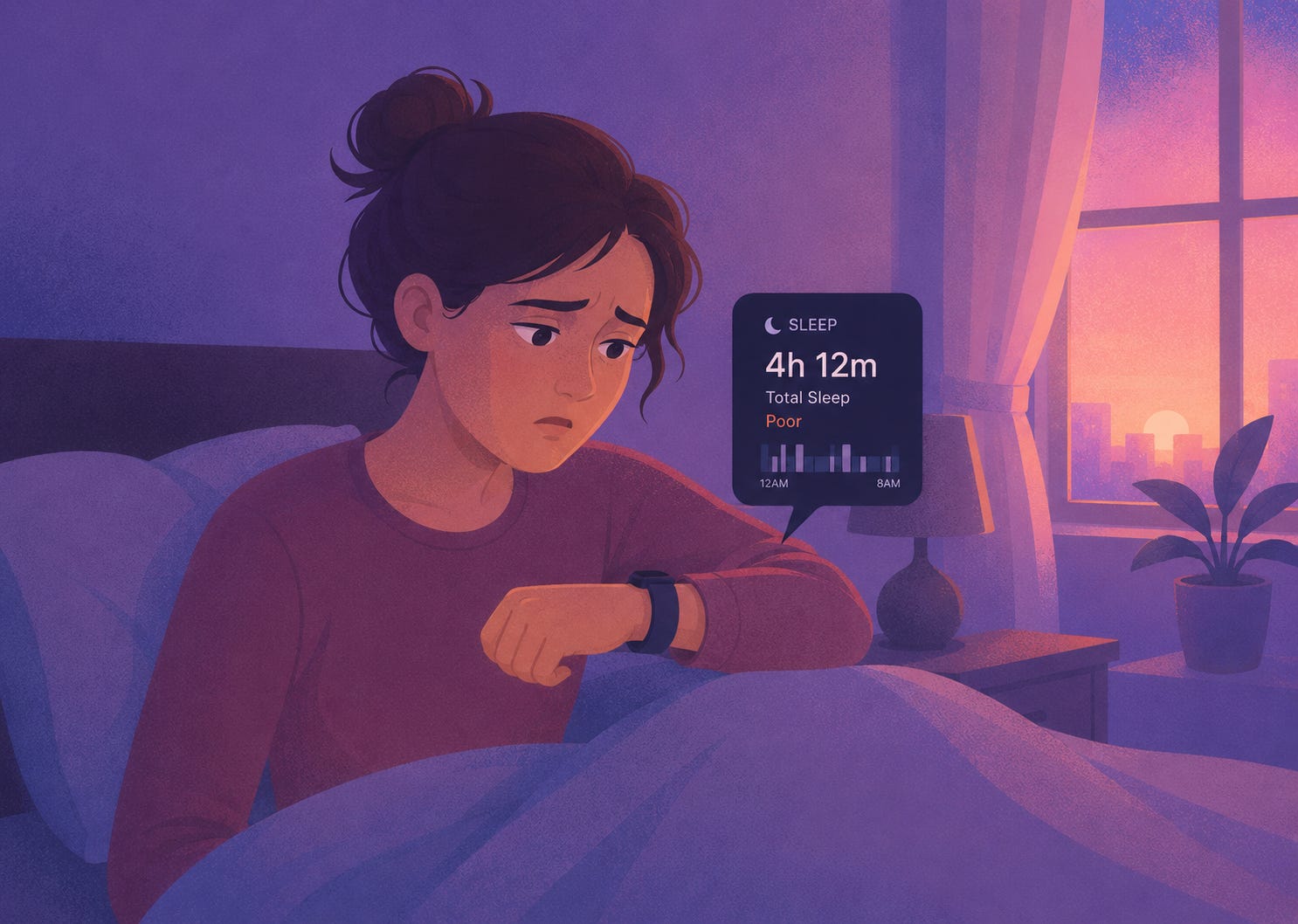
You wake up, and before you’ve even opened your eyes properly, you’ve checked your sleep score. 62. Not great. Suddenly you feel tired - even though thirty seconds ago, before you saw the number, you felt fine.
If that sounds familiar, you’re not imagining it, and you’re not alone. There’s an actual term for it now: orthosomnia. Sleep researchers coined it back in 2017, and it’s becoming more relevant every year as more of us wear a ring, a band, or a watch that scores our sleep every single night.
Here’s the definition, in plain language: it’s when you become so focused on getting a “perfect” sleep score that the focus itself is what ruins your sleep.1 The tracker isn’t malfunctioning. It’s not giving you bad data. The problem is what happens in your head the moment you see the number.
How does a good habit turn into this?
It’s a loop, and it’s a fairly simple one once you see it:
You check your score → you decide it’s not good enough → you get anxious about that → the anxiety itself makes it harder to fall asleep or stay asleep → your actual sleep gets worse → the next score is lower → you check again, more anxiously this time.2
The tool that was supposed to help you understand your sleep becomes the thing actively working against it. And this isn’t rare. Depending on how it’s measured, research puts the number of people showing signs of this somewhere between 3% and 14% of everyone who tracks their sleep.
One large 2026 survey found that a full third of people had quit tracking a health metric altogether - not because they got bored of it, but because it was making them feel worse.3
This isn’t really a sleep problem. It’s an attention problem wearing a sleep costume.
The number on your wrist was never supposed to be the goal. It was supposed to be information - a rough signal to help you notice patterns over weeks, not something to anxiously refresh every morning like a stock price. When a tool built to inform you quietly turns into a standard you have to meet, that’s when it stops helping.
And this shows up well beyond sleep. The same pattern plays out with step counts, heart rate variability, “recovery” scores, even how many minutes you stood up during the day.4 None of these numbers are wrong. But the second you start feeling worse about your body because of what a screen told you, rather than how you actually feel, something’s flipped.
So does that mean you should throw the tracker away?
No - and that’s not really the point here. The data itself is genuinely useful. Knowing your resting heart rate is creeping up over months, or that your deep sleep consistently drops on the nights you eat dinner late, is worth having. The issue was never the tracking. It’s treating a rough estimate like a verdict on how your day is going to go.
A few honest questions worth asking yourself: Do you check your score before you check how you actually feel? Has a “bad” number ever changed your mood for the whole day, even when nothing else was wrong? Have you ever pushed yourself into more sleep or more steps specifically to fix a number, rather than because your body asked for it? If a couple of these land close to home, it doesn’t mean something’s wrong with you - it just means the tool has quietly taken the driver’s seat, and it’s worth taking it back.
The simplest fix, honestly, is the least techy one: use the weekly trend, not the daily number. One night’s score tells you almost nothing on its own. A month of scores tells you something real. And on the mornings the number’s low but you feel fine, trust how you feel. That’s not you ignoring the data. That’s you remembering the data was only ever meant to serve you, not the other way around.
For the curious, here are the references behind the research mentioned above: