

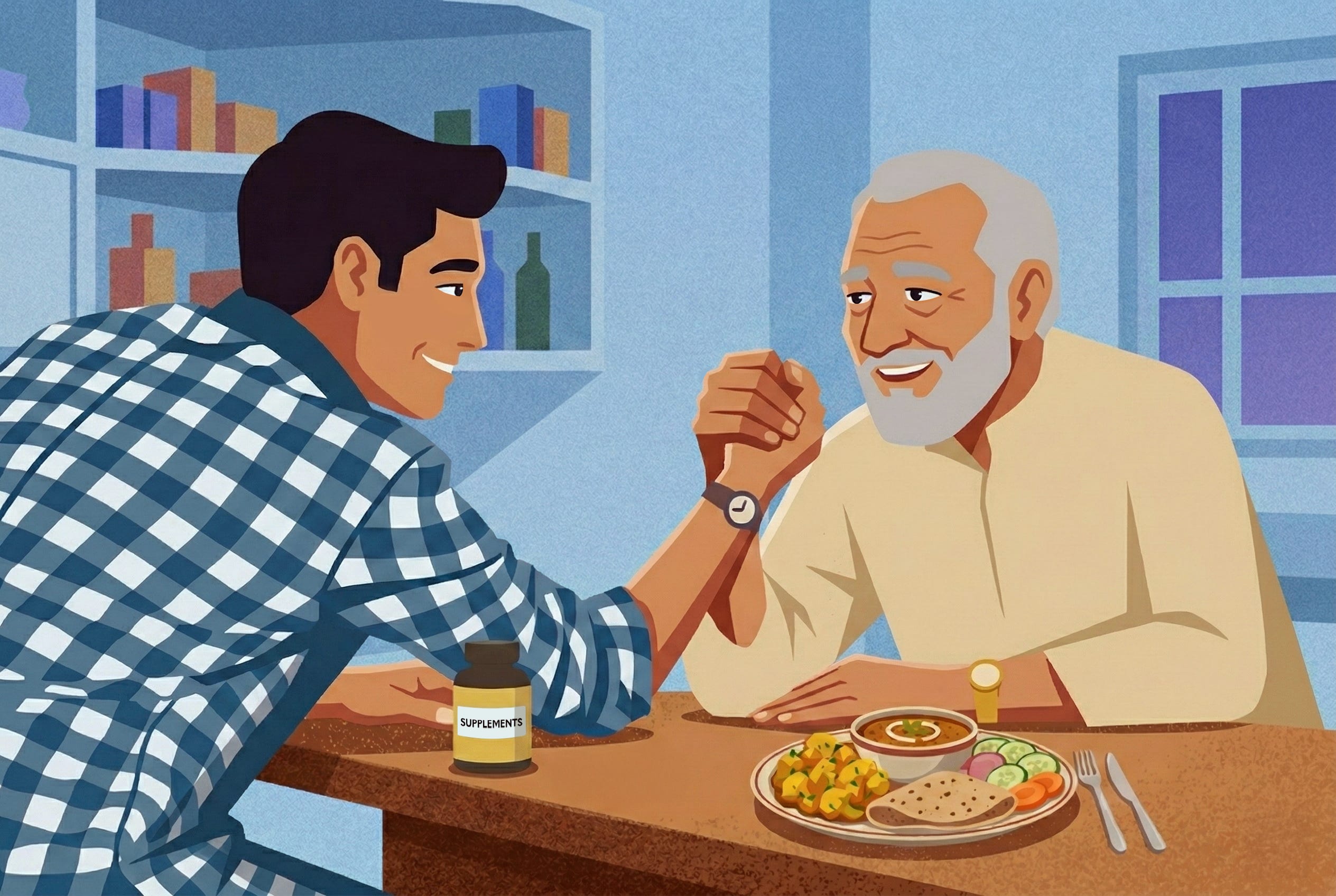
“Back in our day, we didn’t need all these vitamins and supplements. We ate simple food and stayed healthy!”
Sounds familiar? Every Indian has heard some version of this from their parents or grandparents. And honestly, they’re not wrong - they probably didn’t need supplements. But before we dismiss our multivitamins and feel guilty about not being as “naturally healthy” as them, let’s talk about what’s really changed.
The Food We Eat Isn’t the Same Anymore
Here’s something that might surprise you: the tomato your grandmother ate in the 1980s had almost double the iron content of the tomato we’re eating today. Research on Indian food composition data shows that between 1989 and 2017, iron in tomatoes dropped by 66-73%. Cabbage lost nearly half of its key nutrients. Even millets - those supposedly “super” grains - have less thiamine, iron, and riboflavin than they did decades ago.1
This isn’t just an Indian problem. A landmark study by University of Texas researchers compared vegetables from the 1950s to 1999 and found significant drops in protein, calcium, iron, phosphorus, and vitamins across 43 different crops.2 Studies analyzing Canadian food composition data concluded that we’d need to eat eight oranges today to get the same vitamin A our grandparents got from one orange.3
The reason? Decades of intensive farming have exhausted the soil. Research published in Scientific Reports found that Indian soils are now deficient in critical micronutrients including zinc, iron, manganese, and sulphur.4 When soil is depleted, the food grown in it is depleted too. Chemical fertilizers might make crops grow bigger and faster, but they don’t bring back the complex web of nutrients that food naturally had generations ago.
Our Lives Look Nothing Like Theirs
Even if the food were identical, our lifestyles are completely different. Despite living in India, a country blessed with sunshine almost year-round, about 70% of us are vitamin D deficient.5 How does that even happen?
Because we live indoors now. Our grandparents worked in fields, walked everywhere, and spent their days outside in the sun. We work in air-conditioned offices, drive in cars with UV-blocking windows, and live in apartments where direct sunlight is rare. A 2023 study found that 71% of urban adults in Delhi had severe vitamin D deficiency, compared to just 20% in rural areas.6 Cities like Delhi and Mumbai have air pollution so thick it literally blocks the UV rays our skin needs to make vitamin D.7
Then add our habits - covering up to avoid tanning, using umbrellas, applying sunscreen and you see why getting enough vitamin D naturally is nearly impossible for most of us today.
Would They Have Taken Supplements Too?
Here’s the thing: our grandparents’ generation wasn’t opposed to supplements on principle. If they had faced the same nutritional gaps we do, they probably would have taken them too. The difference is, they didn’t need to. Their soil was richer, their food was more nutritious, and their daily lives naturally gave them what their bodies needed. The need for supplementation just wasn’t as widespread or urgent as it is now.
The Real Story
This isn’t about our generation being weaker or less healthy. We’re dealing with fundamentally different circumstances - depleted soils, indoor lifestyles, and pollution levels previous generations never faced.
Supplementation today isn’t about replacing good food or taking shortcuts. It’s about acknowledging that getting all our nutrients from food alone has become genuinely harder in 2026 than it was in 1950. Our grandparents didn’t need supplements because their world was different. We do because ours is too.
And that’s not a failure, it’s just reality.
Want to Dig Deeper? Here are the studies behind what we’ve shared: