

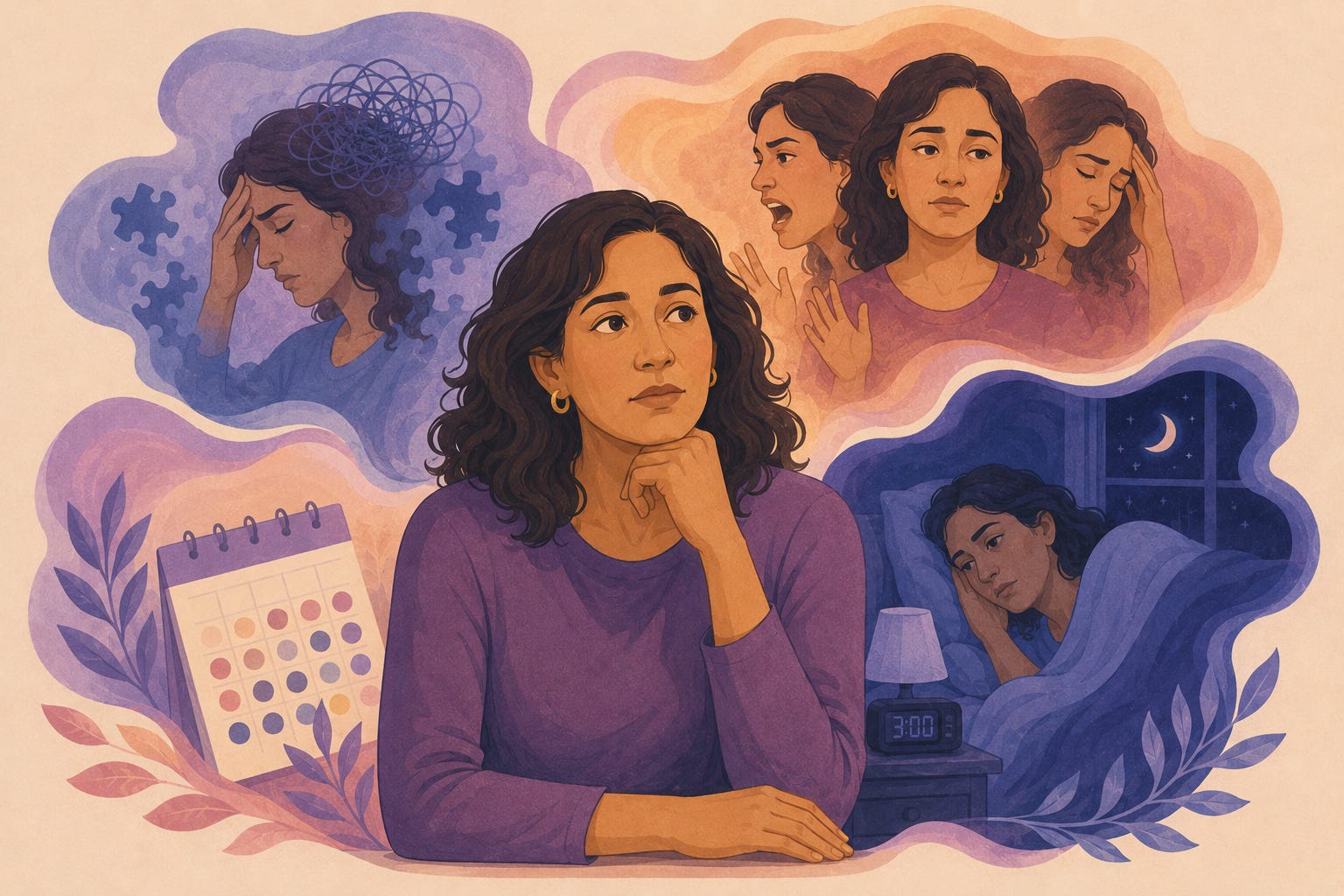
You’re 38 and suddenly you can’t remember why you walked into a room. You’re 40 and your mood swings feel unpredictable - angry one moment, tearful the next, and there’s no pattern to it. You’re 42 and your sleep has become unreliable. You wake at 3 AM for no reason. Your periods are irregular, but you’re not worried because menopause is still years away, right?
You’re probably in perimenopause. You just don’t know it.
And that’s because our entire cultural conversation about menopause is built around one symptom: hot flashes.1
We talk about menopause as if it’s a single event that happens in your 50s. We picture a woman suddenly flushed, fanning herself. We reduce an entire hormonal transition into a five-minute inconvenience.
Meanwhile, the actual transition - perimenopause - lasts 10 years or more. It starts in your late 30s or early 40s. And most of what’s happening has nothing to do with hot flashes.
What We’re Not Talking About
Over 60% of women report brain fog during perimenopause.2 Not hot flashes - brain fog.
This isn’t forgetfulness. This is struggling to find words, losing your train of thought mid-sentence, writing endless to-do lists because you can’t hold anything in your head, and worrying that you’re developing dementia.3
Women call it “cotton wool brain.” Your thoughts feel cloudy. Your focus fractures. And because we don’t have a cultural narrative for it, you assume it’s stress or burnout or just getting older.
It’s actually your brain responding to fluctuating estrogen and progesterone.4
Then there’s mood. About 40% of women experience significant mood changes during perimenopause - irritability, sadness, anxiety, low energy.1 But here’s what makes it confusing: these don’t follow your cycle like PMS used to. They appear randomly because your hormones are fluctuating unpredictably, not cyclically.
You snap at your partner. You feel inexplicably sad. You’re on edge. You tell yourself you’re stressed or burnt out or just “not yourself lately.”
You don’t think: “My brain chemistry is shifting because my ovaries are producing erratic amounts of hormones.”
Sleep becomes fragmented. Night sweats, yes but also insomnia that has nothing to do with hot flashes. You wake at 3 AM and can’t fall back asleep. Your sleep feels lighter, less restorative.5
And here’s where it cascades: poor sleep makes the brain fog worse. It amplifies mood swings. It worsens fatigue. One symptom feeds another.
Irregular periods start first - usually years before hot flashes. Your cycle stretches from 28 days to 35. Then suddenly it’s 50 days, and you wonder if you’re “finally done.” Then it comes back. This unpredictability is the actual beginning of perimenopause.1
But we don’t talk about that. We talk about the day your periods stop completely, which is the END of perimenopause, not the beginning.
The Cultural Silence
Here’s what’s strange: we live in an age of information, yet the conversation about what’s actually happening hormonally during perimenopause is almost nonexistent.
Women are told to expect hot flashes. Everything else comes as a shock, and when it does, they don’t connect it to perimenopause because no one told them it was coming.
A woman in her 40s experiencing brain fog doesn’t think “perimenopause.” She thinks “am I losing my mind?” or “am I not cut out for this job?” or “is something wrong with me?”
She sees a doctor and gets offered a sleep study or antidepressants, because her cognitive symptoms aren’t attributed to hormones.6
She mentions her mood swings and is told to manage stress better.
She talks about her irregular periods and is told, “You’re not there yet.”
The Actual Timeline
Perimenopause can last 4-10+ years.5
It usually starts in the late 30s or early 40s, though some women begin in their mid-30s.
It’s marked by unpredictable fluctuations in estrogen and progesterone - which means symptoms are unpredictable too. One month you feel fine. The next month brain fog is debilitating. Then it lifts.
This unpredictability IS the signature of perimenopause. There’s no pattern because your hormones aren’t following a pattern.
Only after 12 consecutive months without a period do you officially reach menopause. Everything before that - the 10 years of irregular periods, brain fog, mood shifts, sleep problems - that’s perimenopause.5
Why This Matters
Because if you don’t know you’re in perimenopause, you can’t understand what’s happening to your body. And when you can’t understand it, you blame yourself.
You think you’re failing at work because of brain fog. You think you’re emotionally unstable because of mood swings. You think you’re aging poorly. You think you’re not resilient enough.
You don’t think: “My hormones are shifting in ways that are affecting my cognitive function, my sleep, and my mood. This is temporary. This is normal. This is what my body is supposed to do right now.”
The Conversation We Should Be Having
We should be teaching women in their 30s what perimenopause actually looks like.
We should normalize brain fog as a hormonal symptom, not a sign of cognitive decline.
We should explain why mood feels unpredictable.
We should talk about sleep changes years before they start.
We should recognize that irregular periods are the beginning of the transition, not the end.
We should acknowledge that this transition lasts a decade, and it’s affecting your cognition, your mood, your sleep, and your body in ways that have nothing to do with hot flashes.
Because right now, millions of women are experiencing perimenopause without knowing it, and blaming themselves for symptoms that are actually their body doing exactly what it’s supposed to do.
For the curious, here are the references behind the research mentioned above: