

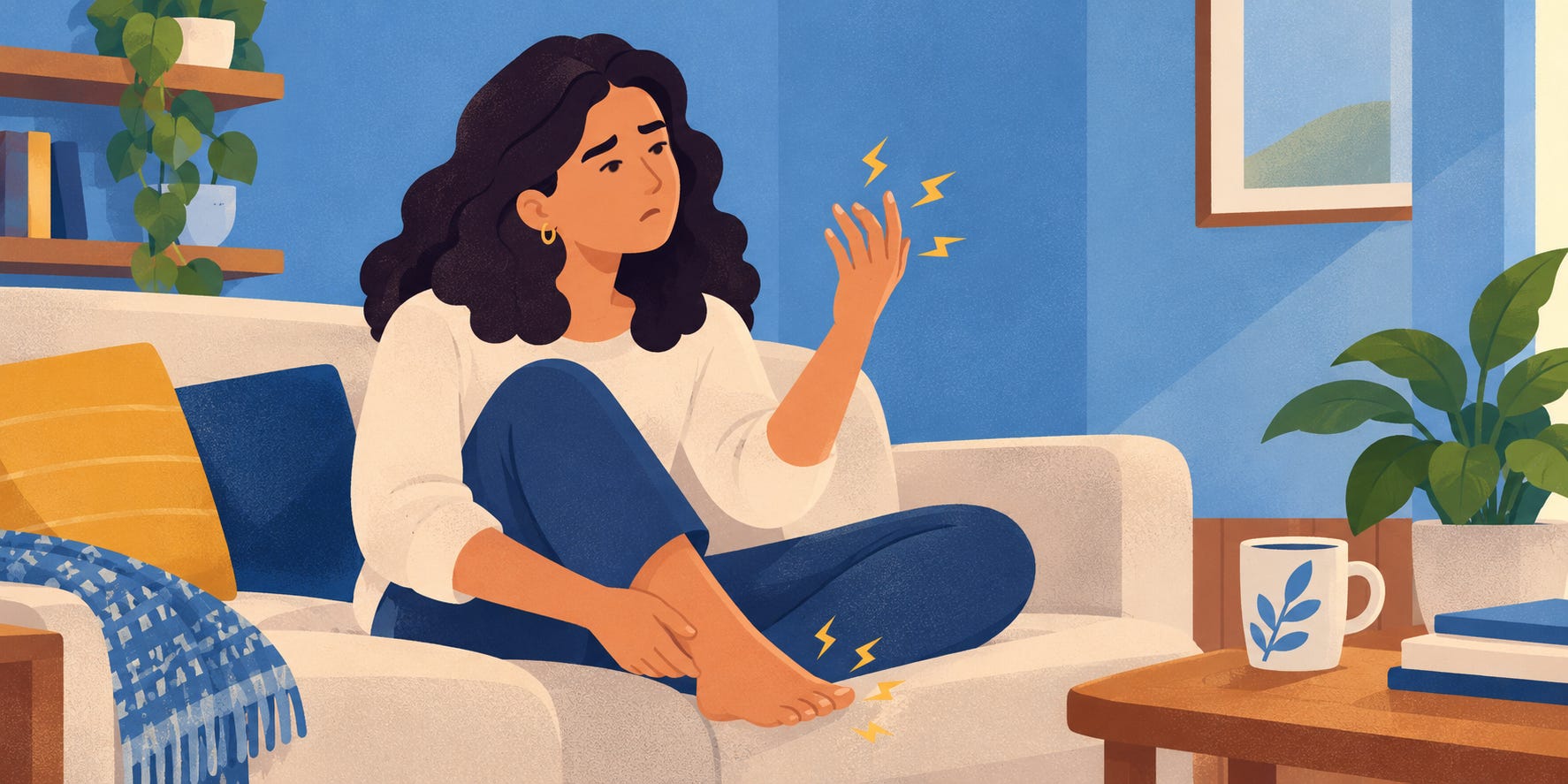
You wake up and your hand has gone numb. Or you sit cross-legged for a few minutes and your foot comes back to life with that fizzy, prickly feeling. Everyone has had this, and most of the time it’s harmless. You moved, the pressure came off the nerve, the feeling returned, and life went on.
But some people feel it a lot more often than that. Tingling toes while watching TV. A burning feeling in the soles at night. Fingers that go numb for no reason you can point to. And because it comes and goes, it’s easy to ignore for months, sometimes years.
It’s worth understanding what’s happening, because it’s often your body’s way of saying something small needs attention before it becomes something bigger.
Think of the wiring in an old house
Every wire in your home has copper inside and a layer of plastic insulation outside. The copper carries the current. The insulation keeps it from leaking or crossing with the wire next to it.
When that insulation is fresh, the lights stay steady. When it wears down, you get flickering bulbs, a fan that slows for no reason, a switch that sometimes works and sometimes doesn’t. The wire itself is fine. It’s the covering around it that’s gone thin.
Your nerves work the same way. They carry signals from your brain to your hands and feet and back, and each one is wrapped in a protective layer called myelin. That’s the insulation. When it’s healthy, signals travel fast and clean. When it wears thin, the signals get patchy, and that’s where the tingling, numbness, and burning come from. The nerve is firing, but the message is arriving crackly.
What keeps that insulation in good shape
Quite a few things do, but one of the most important is vitamin B12. Your body needs it to build and maintain myelin, and when levels run low for long enough, nerves can start to misfire.1 The tingling and numbness in hands and feet are often among the earliest signs.2
And low B12 is far more common than most people think. In older adults, deficiency is estimated at 5 to 20 percent, with low-normal levels affecting many more.1 In India the picture is sharper, because B12 comes almost entirely from animal foods like meat, fish, eggs, and dairy. One hospital study in Eastern India found that around 40 percent of people over 65, and of strict vegetarians, had low B12.3
It’s not only about diet, either. B12 needs a healthy gut to be absorbed, so absorption can drop with age. Long-term use of metformin, a common diabetes medicine, is also linked to low B12. In one study of older adults on metformin, nearly 3 in 10 were deficient.4
Why it gets missed for so long
Because it builds up slowly. There’s no single day when it starts. You get a little more tired, a little foggier, and a little more tingling than last year, and each change is small enough to explain away as age or a busy life.
That’s also why it’s worth taking seriously. B12 is easy to check with a simple blood test, and when low levels are caught early, they’re far easier to correct than after years of going unnoticed.
So what’s worth doing
If tingling or numbness keeps coming back, don’t wait for it to get worse. Mention it to your doctor and ask about a B12 check, especially if you’re vegetarian, over 50, or on metformin. Tingling can have other causes too, so it’s a good idea to get it looked at rather than guess.
The thing to take away is that a feeling you’ve been ignoring may be a signal worth listening to. Your nerves are talking. It just takes a moment to hear what they’re saying.
For the curious, here are the references behind the research mentioned above: