

You’ve probably seen it by now - the “post-meal walk” trend, everyone strolling around the block right after dinner instead of collapsing onto the couch. It looks like just another wellness fad. It isn’t. There’s real, fairly simple science behind why this specific habit works, and why the timing matters more than most people realize.
First, what’s actually happening in your body after you eat
Here’s the simplest way to picture it. When you eat, especially something with carbs, your blood sugar rises as glucose from that food floods into your bloodstream. Insulin’s job is to unlock your cells so that glucose can move out of your blood and into your muscles, where it gets used or stored. Normally, this whole process takes a little while - glucose piles up faster than insulin can clear it, so you get a “spike,” a temporary peak, before things settle back down.
Frequent, sharp spikes over years are linked to higher risk of heart disease and other metabolic issues, not because a spike itself is dangerous once in a while, but because the pattern adds up.1
Why walking, specifically, changes this
Here’s the part that’s genuinely elegant. When your muscles contract during movement, they can pull glucose out of your bloodstream directly without needing much insulin to do it at all.2 Think of it like opening a second door for the glucose to leave through, one that doesn’t require waiting for the insulin key to work. That’s why a walk after eating blunts the spike so effectively: you’ve given the glucose an extra, faster way out.
The part that surprised even the researchers: timing beats duration
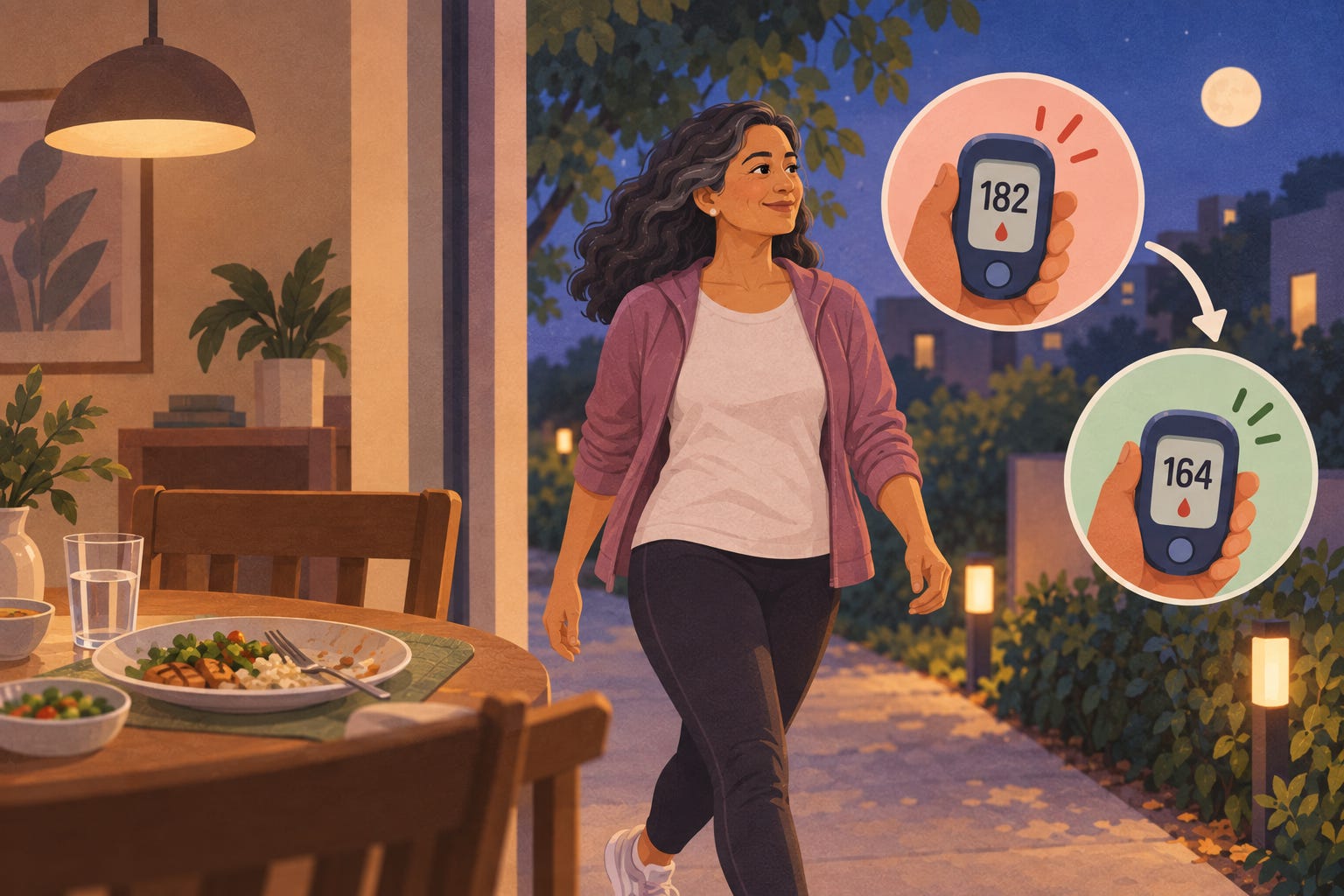
A 2025 study published in Scientific Reports tested this directly. Researchers compared a 10-minute walk taken immediately after eating against a 30-minute walk started half an hour later. The immediate 10-minute walk was uniquely effective at cutting the peak blood sugar spike - more than the longer walk that started later.3 In another controlled trial, a 10-minute walk right after eating brought peak blood sugar down to roughly 164 mg/dL, compared to about 182 mg/dL for people who didn’t walk at all.2
The takeaway isn’t “walk more.” It’s “walk sooner.” A short walk in the window right after eating seems to matter more than a longer walk that starts even 30 minutes later, once glucose is already circulating.
Why this matters even more as you get older
This is where it connects to something bigger. Insulin sensitivity naturally declines with age for everyone - partly from muscle loss, partly from a general metabolic slowdown.4 For women specifically, there’s an added layer: estrogen plays a real role in how easily the insulin “key” turns, and as estrogen fluctuates and then declines through perimenopause and menopause, that sensitivity drops further.5 Either way, blood sugar regulation quietly gets harder with age, often without any change in diet. It’s not something going wrong with you - it’s a predictable shift, and it’s exactly the kind of thing a simple habit like this can help offset.
What this actually looks like in practice
You don’t need a treadmill or a formal walking routine. A gentle stroll - researchers used a comfortable, conversational pace, nothing brisk - for about 10 minutes, started as close to the end of your meal as you can manage, is what the research points to.3 If a full 10 minutes right after every single meal isn’t realistic, even standing up and moving around the kitchen instead of sitting still appears to help some, just less dramatically than an actual walk.
The bigger picture here isn’t about optimizing every single meal. It’s that a habit this small and this achievable is genuinely backed by real mechanism and real data, which is rare enough in wellness trends that it’s worth actually adopting, not just admiring from a distance.
For the curious, here are the references behind the research mentioned above: