

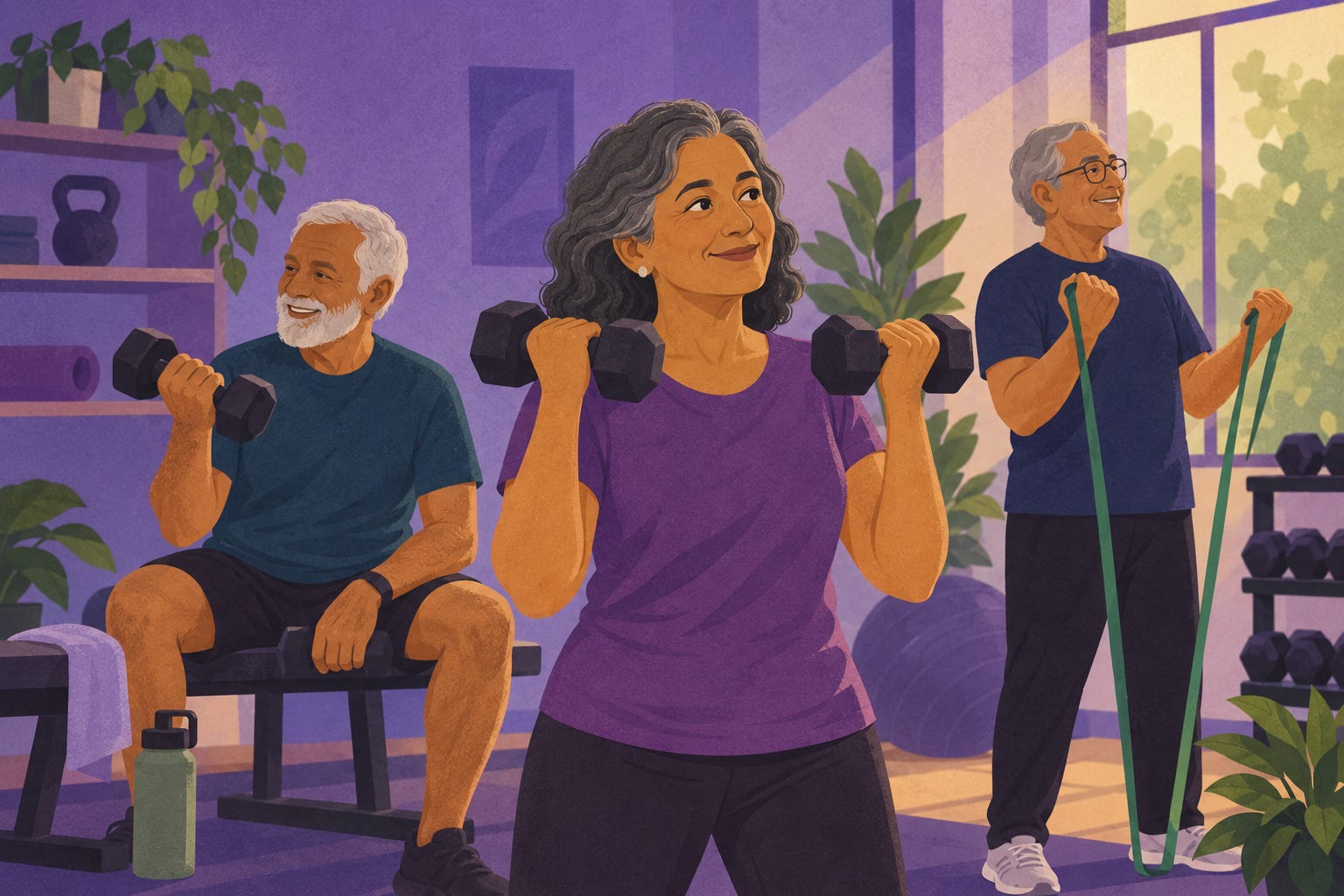
Somewhere along the way, strength training got filed under “aesthetic.” Something you do for definition, for a certain look. That framing isn’t wrong exactly, it’s just missing the part that matters most, especially past 40.
The number that changes how this should be framed
Here’s the simplest way to picture it: imagine your muscle as a bank account you’ve been quietly withdrawing from since your 30s, without ever making a deposit. After age 30, you lose roughly 3-8% of your muscle mass every decade and past 60, the withdrawals speed up.1 By your late 70s, many people have lost close to half the muscle they had in their twenties.2 This has an actual name - sarcopenia - and it’s considered one of the biggest single drivers of frailty, falls, and loss of independence as people age.3
And falls aren’t some rare, unlucky event. Every 11 seconds, an older adult ends up in an emergency room because of one. Every 19 minutes, someone dies from a fall.2 That’s not because floors got more dangerous. It’s because muscle, balance, and reaction speed quietly eroded for years before anyone noticed, until the day a stumble that would’ve been nothing at 40 became something serious at 70.
Why resistance training specifically, not just “staying active”
Walking is genuinely good for you - heart, mood, joints, all of it. But think of muscle like a habit that only strengthens when you actually challenge it. Walking asks very little of your muscles beyond what they already do every day, so there’s not much reason for them to adapt or grow stronger. Resistance training - anything that makes a muscle push or pull against real weight - is what actually sends the signal to hold onto strength instead of losing it. Multiple research reviews now show that resistance training programs, even fairly modest ones, measurably lower fall risk in older adults, largely by directly reversing the exact strength loss that’s driving the falls in the first place.4
Here’s a trial that makes this concrete: 74 older adults did 12 weeks of resistance training, alongside some basic nutrition guidance. Going in, more than a third of the group technically qualified as sarcopenic, losing muscle at a clinical level. After just 12 weeks, none of them did.5 Twelve weeks. That’s how fast this system can respond, even at an age most people quietly assume the window has already closed.
This isn’t about becoming “a gym person”
The bar here is lower than most people expect. Research on older adults with sarcopenia points to something like 2-3 sessions a week, a handful of exercises covering the major muscle groups, moderate effort - not exhausting, just consistent.4 Nothing about this requires becoming a gym person, training for hours, or starting from a high fitness level. It just requires showing up regularly enough for the muscle to get the signal.
The bigger picture - one habit, two jobs
Here’s the part that ties this back to something we covered before: stronger muscle doesn’t just mean less muscle loss. It also means better balance and faster reflexes when you catch a stumble, which is the actual mechanism behind fewer falls. And as covered in an earlier post on creatine, stronger muscle also pulls harder on bone during everyday movement, which helps bone stay dense too. One habit, two protective effects, running off the same twice-a-week routine.
If there’s one thing worth taking from all this: resistance training isn’t a “nice to have” filed under fitness goals. Past a certain point, it’s closer to basic maintenance for staying independently mobile and the earlier it becomes a habit, the smaller the gap it ever has to make up for later.
For the curious, here are the references behind the research mentioned above: