

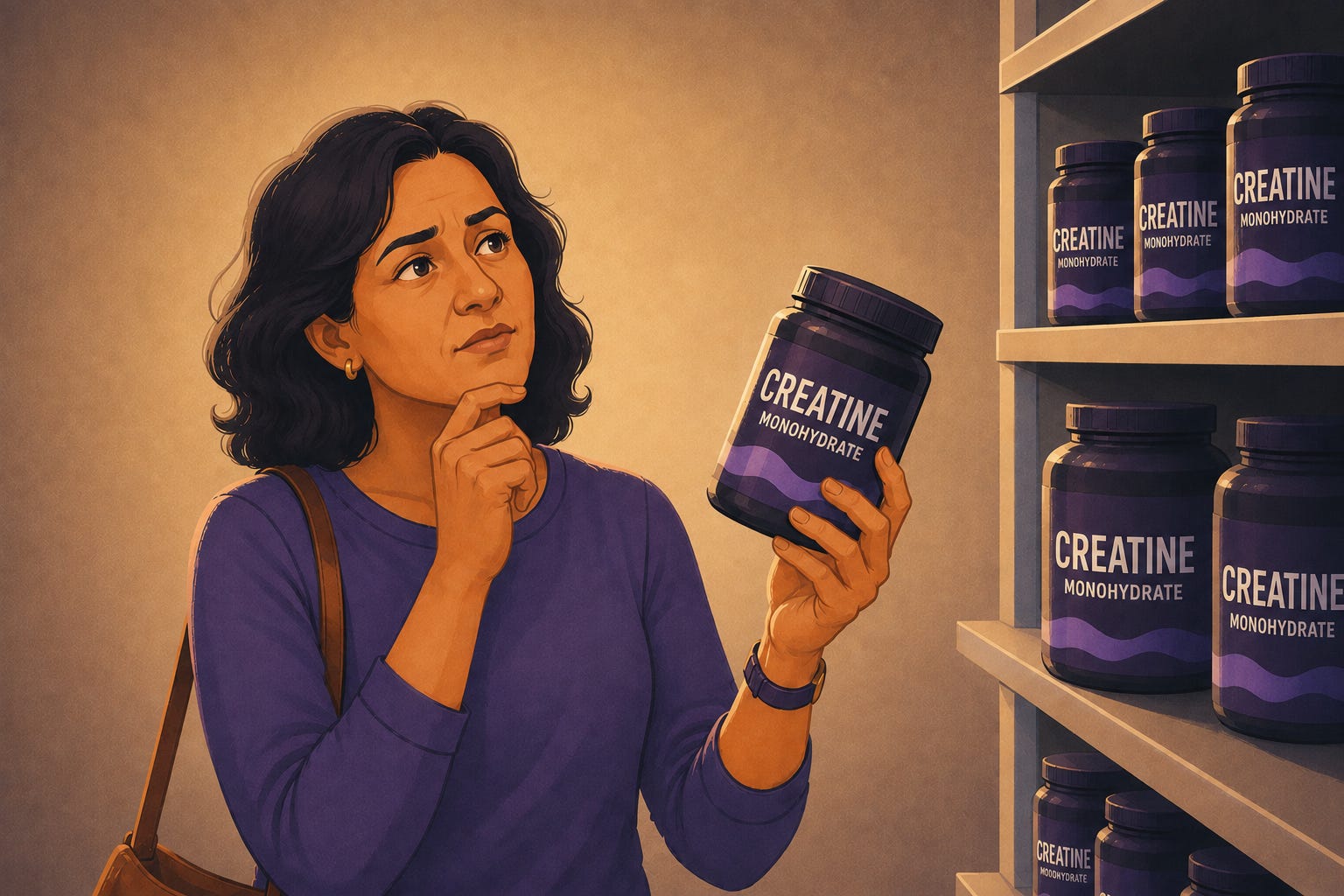
If you’ve spent any time on social media lately, you’ve seen it: creatine, stirred into everything from post-workout shakes to “stacked water” recipes, suddenly the ingredient of the moment.1 For decades, it lived in one lane - bodybuilders, gym bags, and the pursuit of bigger muscles. If you’re a woman in your 40s or 50s, it probably never once crossed your mind as something for you.
And that’s really the actual problem here. Not the trend itself, but the decades that came before it, when women were quietly left out of the conversation.
First, the basics - what creatine actually is
Think of creatine as a tiny fuel reserve your muscles and brain keep on hand for quick bursts of energy - the kind you need to stand up fast, catch your balance, or push through the last few reps of a workout. Your body makes some on its own, and you top it up through meat and fish. Women naturally make about 20% less of it than men, and on average eat 30-40% less of it too.2 So heading into midlife, most women are already starting from a lower fuel reserve - right around the time several other things start working against muscle, bone, and brain all at once. That timing matters more than it might sound like it should.
What it does for muscle - the part with the strongest evidence
Here’s the simplest way to think about it: after 30, you lose roughly 3-8% of your muscle mass every decade, just by default, and after 60 that speeds up.3 It’s a bit like a slow leak in a tyre - you don’t notice day to day, but it adds up. Creatine acts like a top-up for that fuel reserve in muscle cells, which means your muscles can push a little harder in each workout, and more effort in the gym translates to more muscle kept over time, especially when it’s paired with resistance training. This isn’t a shaky, emerging finding either - it’s one of the more established results in sports science, and it’s increasingly showing up in aging research too.
What it does for bone - a smaller effect, but a real one
Here’s a simple way to picture it: bone is a bit like a muscle. Push on it regularly, and it responds by getting stronger and denser. Sit still for years, and it slowly thins out.
Creatine’s role here is indirect - it doesn’t feed bone directly. What it does is help you hold onto more muscle. And stronger muscle tugs on bone harder every time you move - walking, climbing stairs, standing up from a chair. That extra tug is exactly the kind of “push” bone responds to by staying dense.
In one study following postmenopausal women, the group taking creatine lost about 1.2% bone density at the hip over the course of the study. The group on a placebo lost close to 4%.4 Same amount of time, very different outcome and the muscle-to-bone connection is the likely reason why.5
It’s not a replacement for calcium, vitamin D, or weight-bearing exercise - those still do the heavy lifting. But as something added on top, the difference in those numbers is worth knowing.
What it does for brain fog - particularly relevant to midlife
Brain fog is one of the most common complaints women report during the menopause transition, and there’s an actual, simple mechanism behind it. Estrogen fuels the hippocampus - your brain’s memory center - the way electricity fuels a light bulb. As estrogen fluctuates and drops during menopause, that power supply gets unreliable, and memory and word-recall flicker along with it.6 Creatine is involved in how cells produce energy, including in the brain, so researchers are now looking at whether topping up that fuel reserve can help steady the flicker during this exact transition.7 The research here is newer and smaller than the muscle data, but it’s a live, active area of study rather than a stretch.
So, should you actually take it?
That’s genuinely a personal call, and one worth a quick conversation with your doctor, especially if you have any kidney concerns. But if the thing holding you back is outdated information - the old “that’s for bodybuilders” idea - it’s probably worth updating that belief. The typical maintenance dose studied is 3-5 grams of creatine monohydrate a day, though a few of the cognitive studies used a short loading phase at a higher dose first.5 Plain, third-party tested creatine monohydrate is really all you need, nothing fancier required.
But honestly, the bigger point here isn’t even about the supplement. It’s that so much of what gets studied and marketed skips straight past women’s specific biology, and then women are left assuming a whole category “isn’t for them”, when really, the truth was just that nobody bothered to ask the question sooner.
For the curious, here are the references behind the research mentioned above: