

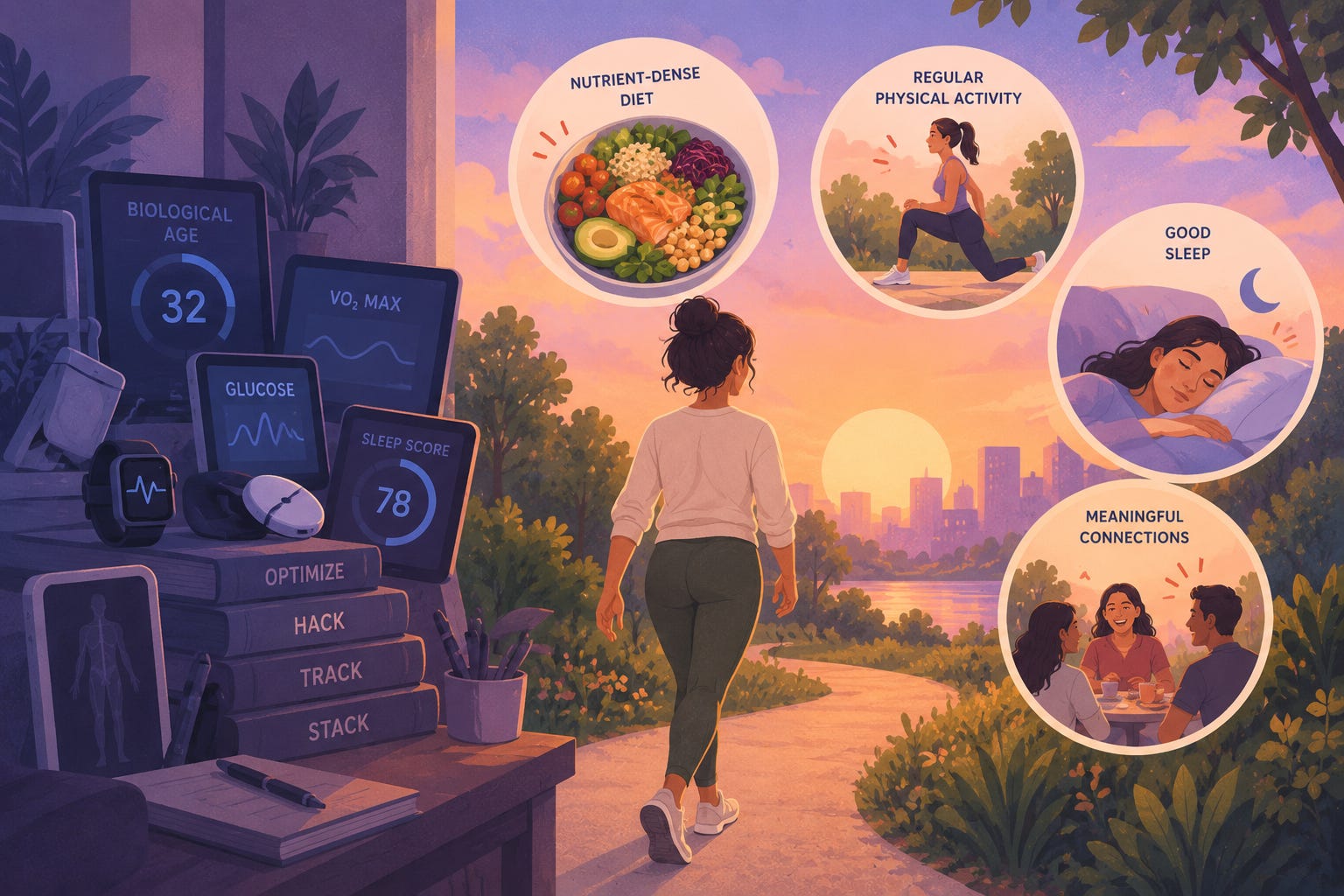
If you’ve spent any time near wellness content lately, you know the vocabulary: optimize, hack, track, stack. Full-body scans. Continuous glucose monitors for people who don’t have diabetes. Recovery scores, VO2 max, biological age tests. It all sounds like the cutting edge of living longer.
So it’s worth paying attention to what happened when U.S. News & World Report actually asked 63 health experts - doctors, dietitians, researchers - to rank what really predicts healthy aging.1 The answer wasn’t cutting edge at all.
The basics won, by a landslide
Here’s the simplest way to picture the results: when experts ranked what mattered most, a nutrient-dense diet and regular physical activity tied for first place, with 89% of experts rating each as equally critical. Sleep came in third.1 That’s it. That’s the podium. Not a single biohacking tool cracked the top three.
One nutrition expert who worked on the survey put it plainly: the habits that came out on top are “remarkably basic, and to some, boring.” Which is really the whole story in one sentence - the things that actually move the needle aren’t exciting enough to trend.
So what about all the tracking and testing?
The experts weren’t dismissive of it, exactly - 40% said wearable trackers can offer some benefit. But nearly a third said tools like wearables, non-diabetic glucose monitors, and full-body scans create more stress than they solve.1 One doctor surveyed explained it simply: these tools are meant to motivate you, but when you don’t hit the number, it’s easy to feel like you’ve failed - even if nothing about your actual health changed that day. A “bad” score can make you anxious about something you weren’t even thinking about five minutes earlier.
Think of it like a bathroom scale that’s a little off. If you trust it completely, a single number can wreck your whole morning - even though the data barely moved the needle on anything real.
The one thing almost everyone underestimates
Here’s the result that might be the most surprising: 59% of experts named social isolation as the most underappreciated accelerator of aging - ahead of diet quality, ahead of exercise consistency.1 We tend to file “having people in your life” under nice-to-have, emotional wellbeing, separate from physical health. The experts surveyed don’t see it that way. Sharing a meal, walking with a friend, having someone to call - these aren’t just good for your mood. They’re doing real work for your body too.
What “enough” exercise actually looks like, according to the experts
No new secret formula here either: 150 minutes of moderate activity a week, plus two days of muscle-strengthening work.1 The muscle piece matters more than people think - it’s not just about strength, it’s what keeps you independently mobile decades from now, and it’s directly tied to fall risk and everyday function as you age.
One place biohacking tools might genuinely help
The experts weren’t anti-technology across the board. Grip strength, VO2 max, and skeletal muscle mass came up as markers worth knowing, especially before age 50 - not to obsess over daily, but as occasional checkpoints that tell you something real about long-term function.1 The difference is in how it’s used: a number checked a few times a year to understand a trend is useful information. The same number checked every morning, treated as a verdict on how the day is going to go, is where it tips into something that works against you.
The actual takeaway
Nobody in this survey said don’t ever use a tracker, and nobody’s telling you biohacking is a scam. What the data actually says is simpler: eat well, move consistently, sleep properly, and don’t skip the people in your life. None of it requires new technology, and most of it doesn’t require spending money at all. The fanciest tool in the room still can’t outperform the boring habit done consistently for years.
For the curious, here is the reference behind the research mentioned above: